
Mini Bellagio Fountains with Arduino :: Member Project
After visiting Bellagio fountains, David Payne (A member of PEA) was inspired to build his own miniaturized version using Arduino. He is getting started with an Arduino Mega, RV pumps, servos, motion sensors, and more as the building blocks for his fountain.
Read below to see how things are coming together for this work in progress.
Why build a miniaturized Bellagio fountains?
I saw the Bellagio fountains in Las Vegas and was blown away…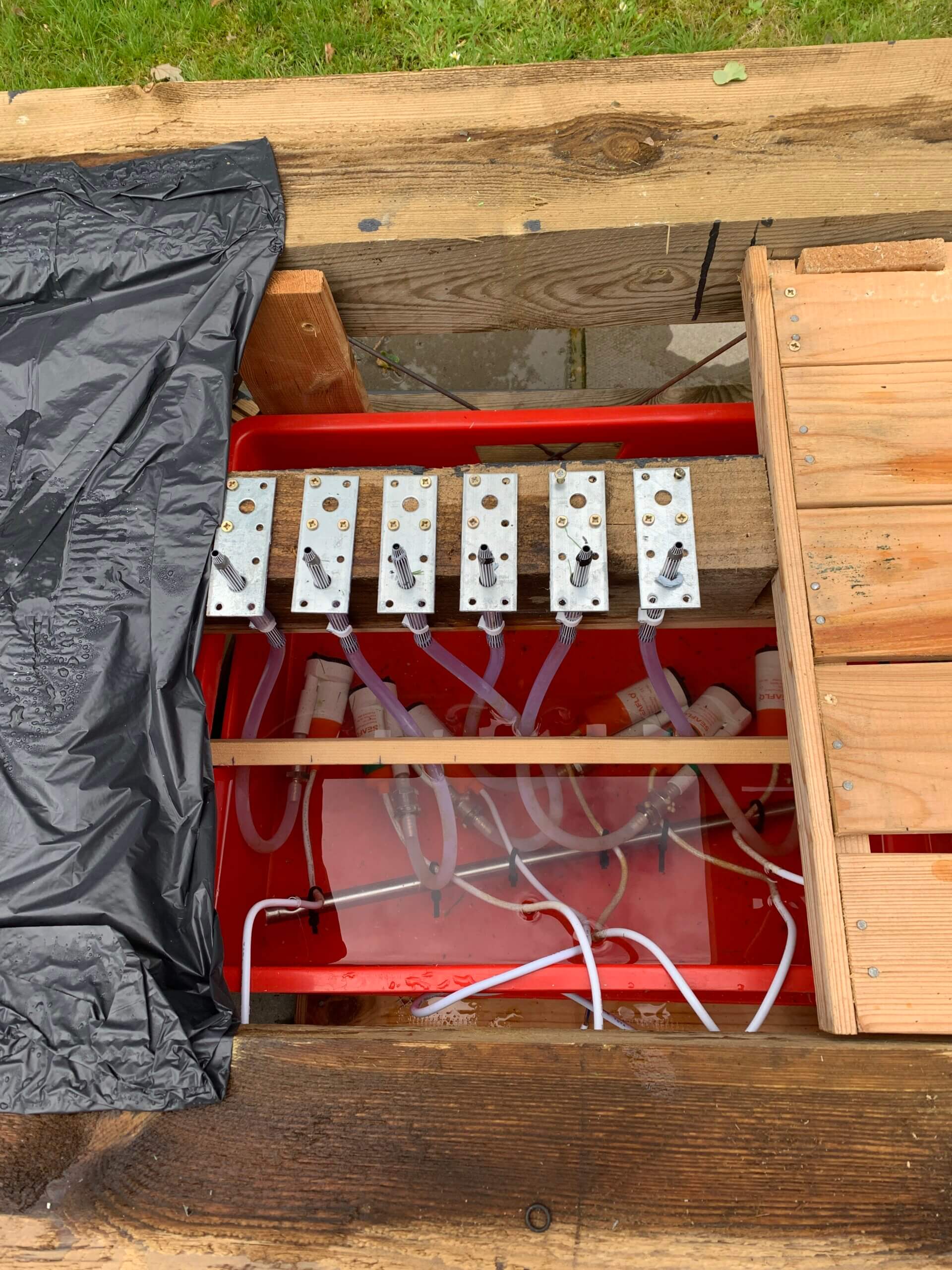
How does your project work?
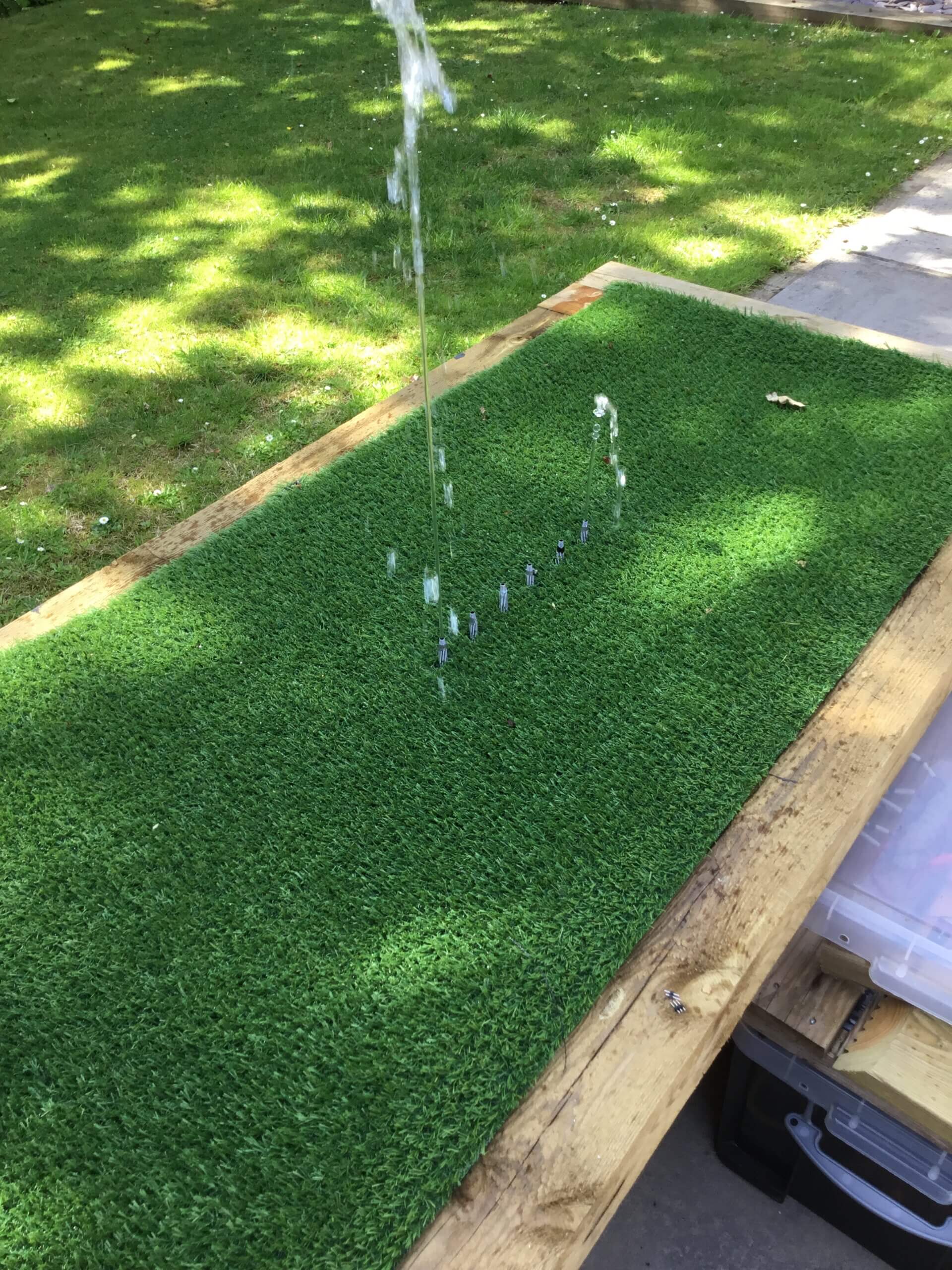
The project is to take inspiration from the famous Bellagio fountains in my construction of a domestic garden water feature. I made some decisions that enabled me to take the project through various stages.
So far, I have used 6 individual 12V caravan (RV) water pumps that would give me 6 controllable water jets. This would allow me to fire the water jests in sequences a la Bellagio.
The next stage will be to add addressable LED strips/rings to produce a supporting light show.
After that I aim to build a mechanism that is servo powered to tilted the jets thus making a 3D water space.
What was your biggest struggle as you worked through this project?
Getting the right pump. Initially I tried a 240V pump with solenoid valves. After some trials I found the caravan water pumps, fitted with non-return valves, to be ideal.
What more are you planning to do?
The project has a long way to go! I need to find out more about running functions in my sketch so that the jet patterns are more complex.
I have yet to link in my neopixel display, my 2D jet Control and a proximity sensor so the whole feature activates when somebody gets close.
What can you say you have learned about programming and/or electronics through the creation process?
I have a good understanding of basic programming but it is mainly governed by the command delay() ! I need to find out more about switch/case and also about using ‘interrupts‘.
Was the training at Programming Electronics Academy able to help you build your skill?
It helps me as someone who ‘dips in and out’ of material
About David:
David is a retired physics teacher and has been into electronics for most of his life, and been programming for nearly 3 decades.









Hi David, thanks for sharing your project. I’m inspired by it. I am currently working on an Arduino servo project myself and am making some progress. Would be cool if we could “share notes” -Geo
Human imagination and Thinking ( in the right direction) is a marvel and can make wonders. Tinkering is the best way of exploring possibilities that really makes a tangible change.Tinkering with Arduino, as far as i have gone through, is like giving ‘wings’ to your imagination. Definitely, sky is not the limit. you can explore BEYOND !
Inspiring. Any chance of seeing a video and maybe the code? Also try out some nozzles that can give you a laminar flow.
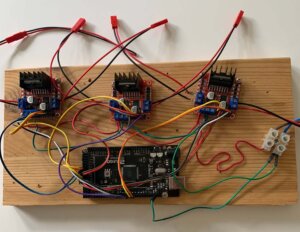
I’m hoping to have some video to post next week. I ran into a major problem using the H bridges to control the pumps. Each pump draws about 1.6 amps and as they are switching on & off frequently the total current was manageble. However in my “routine” I had all 6 pumps on and using PWM to bring the pumps up to full power. It was too much and the H-bridges shut down.
Regarding laminar flow nozzles … it would be fun to try some out. I did look into it but I couldn’t find anything that would fit on a 6mm diameter tube.
Wow! The data sheet for the L298 says: Motor Supply Current (Maximum): 2A. I wonder why it is shutting down. So will you be getting a replacement for the L298?
Hi David,
Super cool project. Well done! Would you willing to share the 12V caravan (RV) water pump and one-way valve specifciation? I’m building something similar and would benefit from your exploratory work.
Thanks!
Steve
Hi Steve, thanks for the words of encouragement!
The 12V pump is available Under the brand name of “Seaflo”. There are two versions, one pumps 12 litres per min, the other pumps 16 litres per min. They cost about £13 per pump.
I chose these pumps because I can then control them independently and it makes for a more variation in the display.
The pipework is based on 8mm i.d. Pvc tubes and there are plenty of suppliers that sell 8mm bore non-return valves (typical cost £5 per valve)..
I’m currently working on a servo controlled nozzle to give me some 2D control.