
Is the Arduino UNO R4 for you? Find out here.
The iconic Arduino UNO Rev 3 has a new and power packed revision: the Arduino UNO R4.
With more memory, a faster processor, and a number of new features, the Arduino UNO R4 is the perfect board for anyone looking to create powerful and sophisticated projects with the ease and fun of the Arduino ecosystem.
Let’s take a closer look!

Get your Arduino UNO R4 here >>
Why a new Arduino UNO Rev4?
According to Arduino, the community at large was asking for improvements on the Arduino Rev 3.
There were certain things like the A/B USB cable type that you had to steal from your (roommate’s) printer, and the limited SRAM and flash memory you’d run into for larger projects.
And so Arduino obliged on all the requests and really delivered an impressive new revision: The Arduino UNO REV 4
Revision 4 actually has 2 models, one is called the UNO R4 Minima, and the other is the UNO R4 WiFi which will use the Espressif S3 WiFi module in addition to the new RA4M1 microcontroller.
Arduino UNO R4 VS R3
So, what’s the difference between the Arduino UNO R4 and the Arduino UNO R3?
Here’s a comparison:
| Specification | UNO R4 – Minima | VS | UNO R3 |
| Microcontroller | RA4M1 (Arm Cortex®-M4),32-bit Processor | ⬅︎4X | ATmega328P, 8-bit Processor |
| Clock Speed | 48 MHz | ⬅︎3X | 16 MHz |
| USB-Connector | USB-C | ⬅︎ | USB-B |
| Pins | -14 digital I/O -6 PWM -6 analog input -1 analog output (DAC) ~14 External Interrupts | 🟰 🟰 🟰 ⬅︎ ⬅︎ | -14 digital I/O -6 PWM -6 analog input -0 analog output (DAC) -2 External Interrupts |
| Connectors | Serial Wire Debug (SWD), ICSP | ICSP | |
| Communication | UART 1 Native & 1 on TX/RX Pins, I2C, SPI, CAN | ⬅︎ | UART, I2C, SPI |
| Power | -I/O Voltage 5V -Input voltage (nominal) 6-24V -Power Supply Connector Barrel Jack -DC Current per I/O Pin 8 mA | 🟰 ⬅︎ 🟰 ➡︎ | -I/O Voltage 5V -Input Voltage (recommended) 7-12V, (limit) 6-20V -Power Supply Connector Barrel Jack -DC Current per I/O Pin 20 mA |
| Flash Memory | 256 kB, 8 kB data | ⬅︎8X | 32 kB |
| SRAM | 32 kB | ⬅︎16X | 2 kB |
| EEPROM | 8 kB | ⬅︎8X | 1 kB |
| Dimensions | Width 53.4 mm, Length 68.6 mm | 🟰 | Width 53.4 mm, Length 68.6 mm |
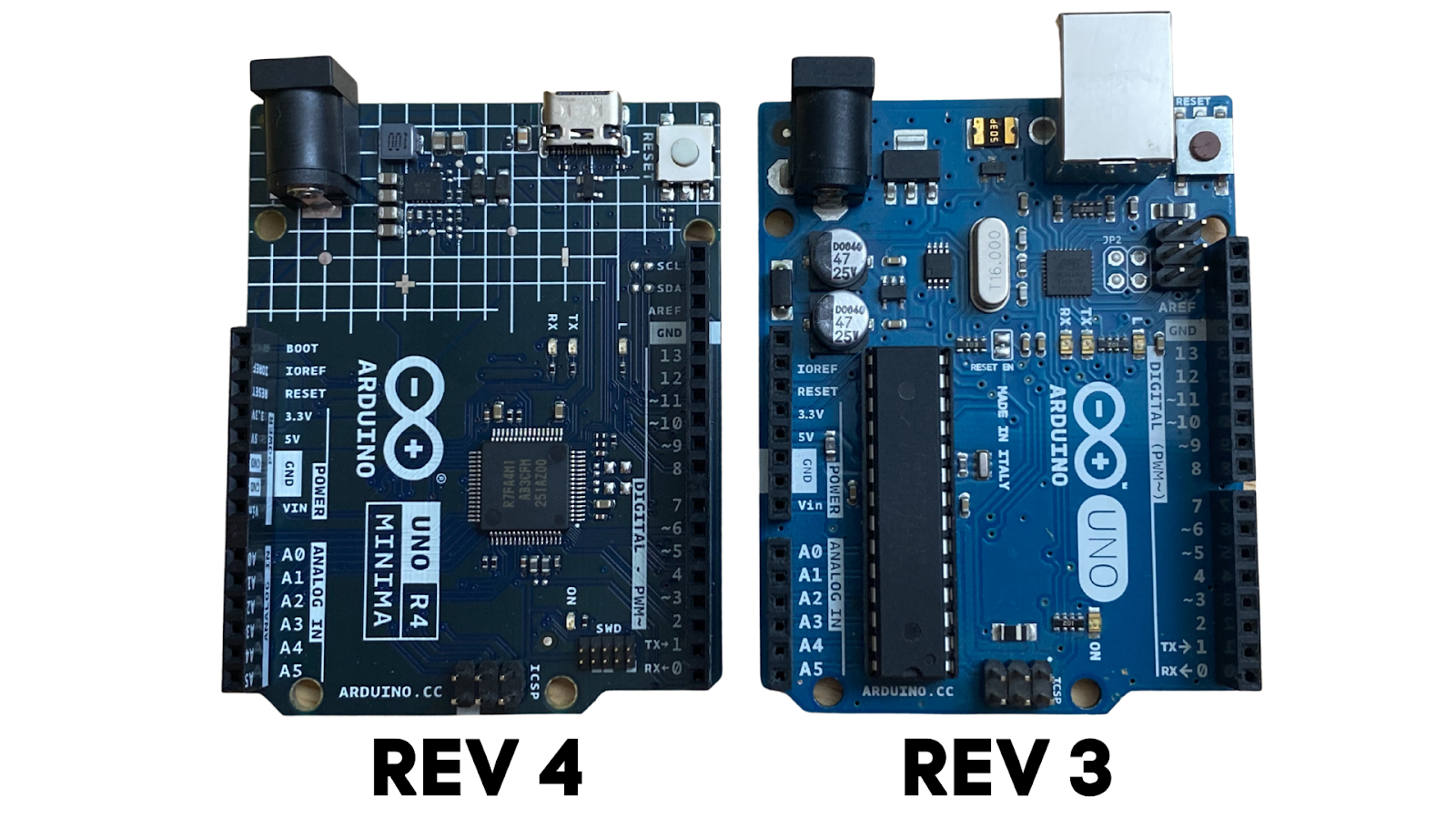
As you can see, the big difference between the two boards is the microcontroller – the Arduino Rev R4 has a RA4M1 (Arm Cortex®-M4) which is a 32-bit Processor and clocks at 48 MHz, while the Rev 3 has an ATmega328P which is an 8-bit processor and clocks at 16 MHz.
That’s a big difference! Plus, you get more memory all around with the UNO R4.
And of course, we get to ditch the bulky USB A/B type cable for a USB C – much more slick.
So these are the differences, but why I really like the Arduino R4 is for what has stayed the same…
Arduino UNO R4 Hardware Compatibility
I think the best thing about the Arduino UNO R4 is what hasn’t changed. And these are some really important Non-changes.
First off, the Rev 4 has a 5V operating voltage, just like the Rev 3.
Plus, the footprint is the EXACT same – so it can fit any shield that you have for the previous revision.

Arduino has also made software compatibility a big priority for the R4 and most existing code libraries and examples that work with R3 should be a seamless switch to the Arduino UNO R4.
All of the above is a big deal, because the Arduino UNO Rev 3 has been the number one, most iconic, quintessential, Rocky Balboa of Arduino boards.
The sheer amount of code, shields, tutorials, wedding suits built specifically for the R3 is massive – so making the Arduino UNO R4 a near drop in replacement for the R3 leverages a ton of that ecosystem.
Gut reactions to the Arduino UNO R4
My first reaction to the Arduino R4 was concern. I’ve been using the UNO Rev 3 for over a decade, and it feels like a close friend. I’ve learned so much about microcontrollers using this board – why do I need anything else?
But as I started checking out the Arduino UNO R4 – I have to say, in my opinion Arduino has done a great job with this revision.
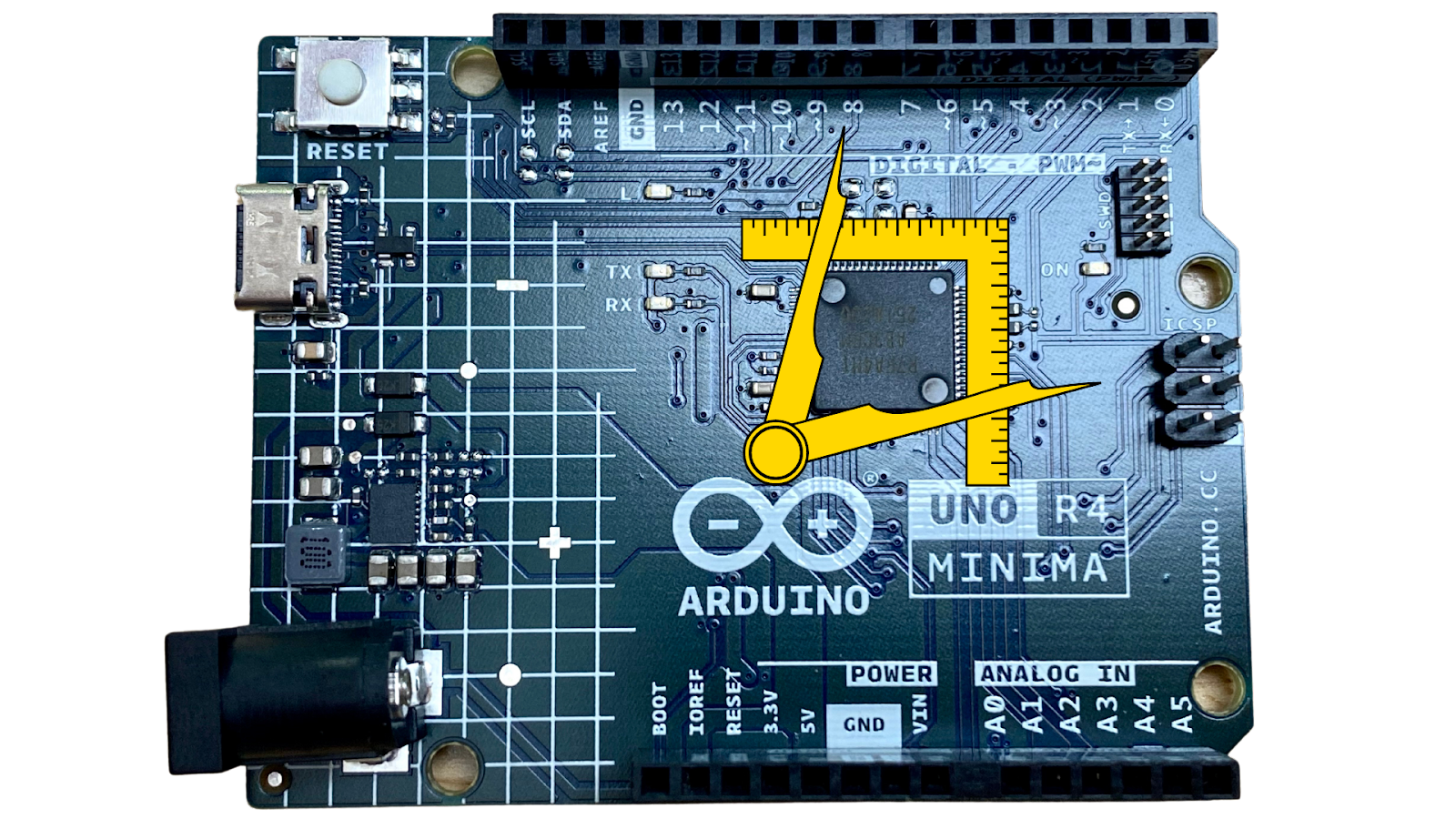
Arduino has always been on the ball aesthetically, and that hasn’t changed with the UNO R4. It looks neat! It has a cool solder mask, and the plastic headers have the super useful feature of having the pin description written on both sides.

Even small details, like the heart shaped solder point next to “Open source is 🩶” is really neat. And if you look closely at the parts layout, you can easily see the square and compasses design has been incorporated.
Who is the R4 for?
This is a great question – I’d say if you’re brand new to Arduino – then the Arduino R4 is a good fit. Though, I would make the same statement about the R3 – which is more than adequate when you’re learning to program microcontrollers with Arduino.
Uploading code, writing code, and connecting circuits for the R4 and R3 is nearly identical aside from selecting a different board in the Arduino IDE. It’s just with the Arduino UNO R4 you get a ton more performance packed in…
So, who is the UNO R4 ideal for? I would say beginner friendly as well as advanced project ready – it really spans a big spectrum!
Is the Arduino R3 dead?
A resolute No! Arduino has made it clear that “The Arduino UNO R3 will still be available and supported, at the side of all makers who want to work with its 8-bit AVR microcontroller.”
As mentioned previously, the Arduino UNO R3 has built up such a following that sunsetting it would be a huge loss. Instead, you’ll now have more options to choose from in the Arduino UNO form factor.
What about the Arduino UNO R4 WiFI?
The Arduino UNO R4 Wifi will be just like the Arduino UNO R4 Minima, but in addition it will have an Espressif S3 WiFi module for connecting to the internet.
So if you’ve ever heard about the popular esp32 – that’s what will be powering the internet connectivity. We’ll have another article highlighting this other UNO R4 version in the coming weeks – stay tuned!








Hi Michal. I just the video on the Arduino R 4 I like it
It’s me courses in away ya !!
Thanks!
My biggest problem is coding. I ca’t afford online pay courses, any suggetions?
There are lots of coding books at libraries – they can be great!